Products
CP pallets — CP1 to CP9
The chemical industry standard since 1991, defined by the VCI (the German chemical industry association) and specified by the ECTA — now managed by EPAL. 9 standardised models, the formats chemical logistics expects at every European plant, port and container terminal.
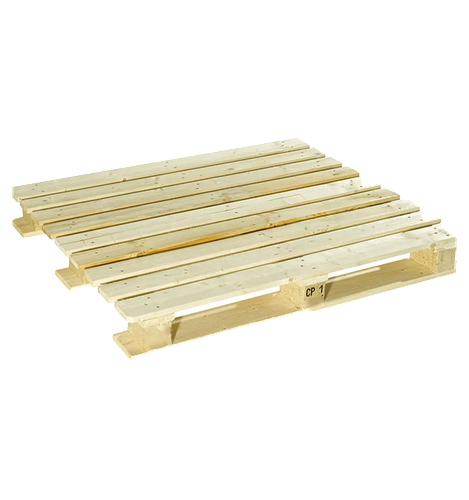
CP1
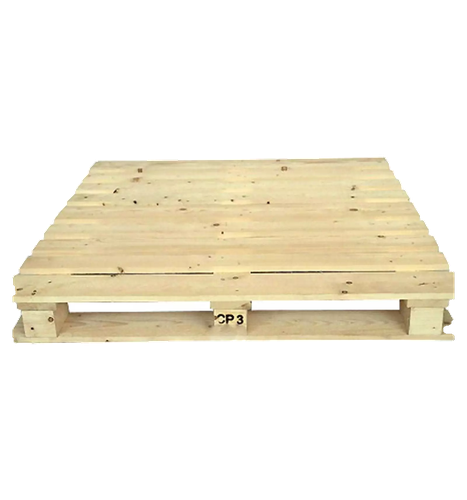
CP3
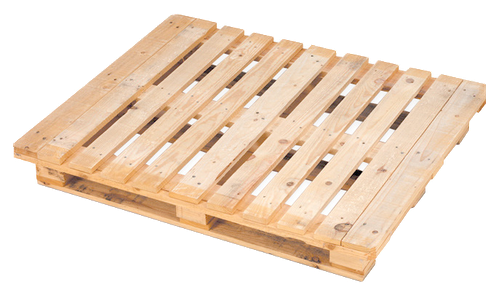
CP6
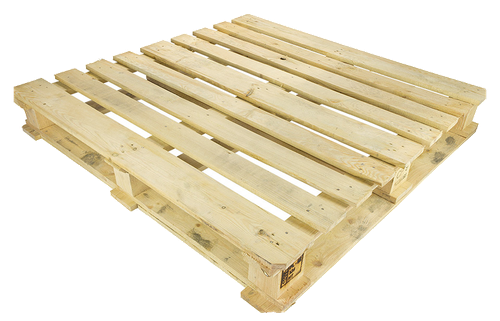
CP9
Understanding CP pallets
CP pallets (“Chemie Paletten”) fall into two families. Models CP1 to CP5 are skid pallets with an open bottom deck — lighter, suited to standard loads. Models CP6 to CP9 have a perimeter base (closed bottom frame) giving better stacking behaviour. For the CP8 and CP9, manufacturers often state higher load ratings.
Characteristics common to all models: 9 blocks in a 3×3 layout, chamfered corners for shrink-wrapping, chamfered bottom-board edges, softwood construction (pine, fir, Douglas fir), residual moisture max 18–30%, dimensional tolerance +0/−2 mm. CP pallets are repairable and reusable — many chemical sites run them in closed loops between plants and formulators.
Because the specification is industry-wide, a CP3 loaded in France is the same CP3 expected at a packing line in Antwerp, Rotterdam or Tarragona — which is why buyers across Europe source them by model number, not by description.
CP1 to CP5 — skid pallets
Open bottom deck. Lighter build; indicative rating of 1,500 kg dynamic / 4,000 kg static for CP1, CP3, CP4 and CP5, varying by manufacturer. For the CP2, see the note below the table.
| Model | Dimensions (L×W×H) | Weight | Dynamic load | Static load | Main use |
|---|---|---|---|---|---|
| CP1 | 1000×1200×138 mm | 23–32 kg | 1,500 kg | 4,000 kg | Bags, big bags, cans, drums |
| CP2 | 800×1200×138 mm | 17.5–24 kg | Per manufacturer * | Per manufacturer * | Cartons, fibre drums — Euro footprint |
| CP3 | 1140×1140×138 mm | 23.5–32 kg | 1,500 kg | 4,000 kg | Drums, octabins — sea container |
| CP4 | 1100×1300×138 mm | 23.5–33 kg | 1,500 kg | 4,000 kg | Bags, bulky loads |
| CP5 | 760×1140×138 mm | 16.5–24 kg | 1,500 kg | 4,000 kg | Cartons — 20-ft / 40-ft container |
* The CP specification sets no handling load per model: the dynamic and static values on this page are indicative and vary by manufacturer, and we give no indicative value for the CP2. Reference nominal racking loads under the CP specification (edition 7, table 13): about 520 kg (CP1), 750 kg (CP2), 460 kg (CP3), 500 kg (CP4) and 690 kg (CP5), that is, 50% of the average breaking load measured on pallets made of low-strength timber that still meets the specified quality. The specification states that these values also apply to less severe uses than racking, such as block stacking. They are reference values for a new pallet tested as described in the specification; for a used pallet, a concentrated load or another racking configuration, have the permissible load checked.
CP6 to CP9 — perimeter-base pallets
Closed perimeter frame. Improved stacking. For the CP8 and CP9, manufacturers often state higher values (2,000 kg dynamic / 6,000 kg static, as an indication).
| Model | Dimensions (L×W×H) | Weight | Dynamic load | Static load | Main use |
|---|---|---|---|---|---|
| CP6 | 1200×1000×156 mm | 23.5–35 kg | 1,500 kg | 4,000 kg | Bags, cartons — stackable (= CP1) |
| CP7 | 1300×1100×156 mm | 23.5–40 kg | 1,500 kg | 4,000 kg | Bulky bagged goods — stackable (= CP4) |
| CP8 | 1140×1140×156 mm | 24–40 kg | 2,000 kg | 6,000 kg | Octabins, FIBC — central discharge hole |
| CP9 | 1140×1140×156 mm | 25–38 kg | 2,000 kg | 6,000 kg | Drums, big bags — sea container |
The dynamic and static values in this table are indicative and vary by manufacturer. Reference nominal racking loads under the CP specification (edition 7, table 13): about 930 kg (CP6), 830 kg (CP7), 1,000 kg (CP8) and 810 kg (CP9). The specification states that these values also apply to less severe uses than racking, such as block stacking. They are reference values for a new pallet tested as described in the specification; for a used pallet, a concentrated load or another racking configuration, have the permissible load checked.
Model correspondences: CP1 ↔ CP6 (same 1000×1200 footprint), CP4 ↔ CP7 (1100×1300), CP3 ↔ CP8 ↔ CP9 (1140×1140). The CP6–CP9 versions add the perimeter frame for better stacking. CP2 (800×1200, Euro footprint) and CP5 (760×1140, container footprint) are unique formats with no perimeter-base equivalent.
ISPM 15 is mandatory for exports outside the EU — and for the UK since Brexit. Every CP model can be supplied heat-treated with IPPC marking. More about ISPM 15 → · Country list 2026 →
Not sure which CP model you need? Our dedicated guides match the model to your packaging type (drums, big bags, octabins, bags). Which CP pallet model? → · Chemical pallet by product →
The most widely used models in Europe are CP1, CP3, CP6 and CP9. CP pallets are quoted on request — new or used, sorted lots. See also our published prices for standard pallets.
Request a CP pallet quote →